
Learn › Credit Genius Luci lessons › Lesson 6
The Debt Time Clock
Old debt runs on two clocks
A collector calls about a credit card you stopped paying years ago. Is it too old to count? Too old to show up on your report? Too old to be sued over? Those are three different questions, and most people mix them up.
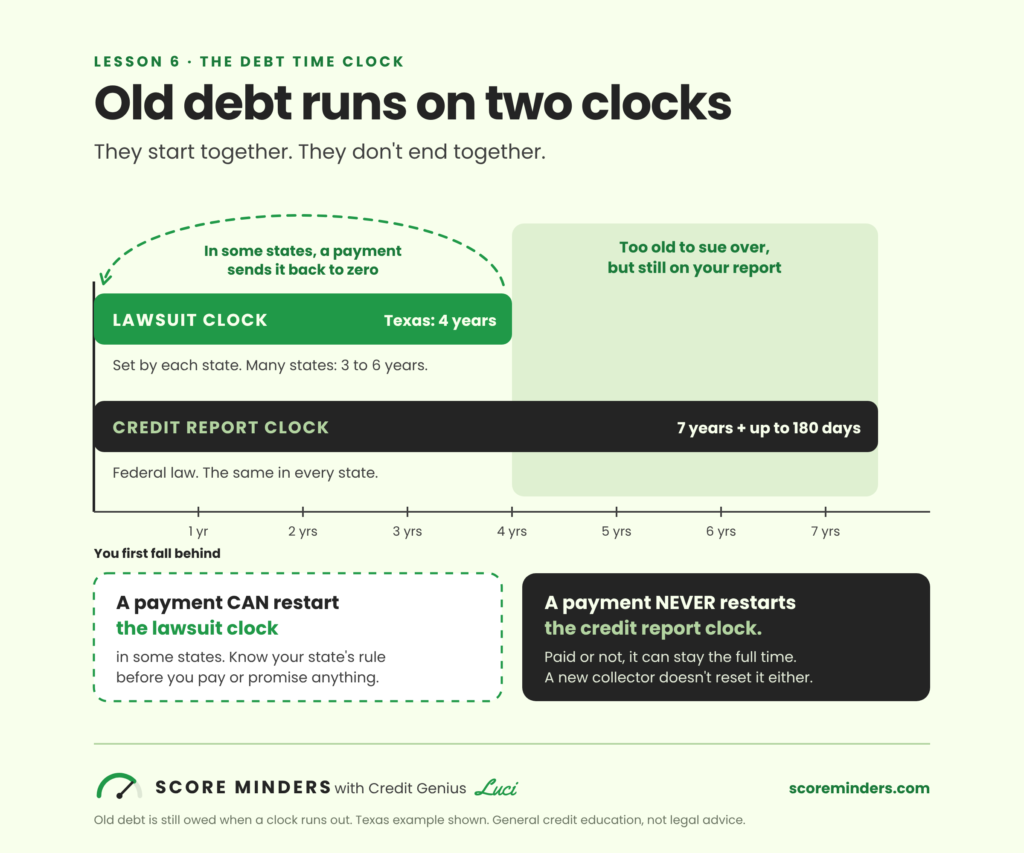
Here’s the rule nobody hands you: old debt runs on two separate clocks.
- The credit report clock. How long the account can stay on your credit report. This is federal law, the same in every state.
- The lawsuit clock. How long someone has to sue you over the debt. This is called the statute of limitations, and every state sets its own.
The two clocks start at different times, run for different lengths, and follow different rules. A debt can be too old to sue over and still be on your report. It can be off your report and still be young enough to sue over. And in some states, one wrong move can restart the lawsuit clock.
One more thing before we start: an old debt doesn’t disappear when a clock runs out. It’s still owed. The clocks only limit what can be done about it.
The two clocks side by side
The credit report clock is about what lenders can see. The lawsuit clock is about whether you can be taken to court. Keep them separate in your head and old-debt calls get a lot less scary.
What can restart the lawsuit clock
The credit report clock can’t be restarted. Paying, selling the debt or switching collectors doesn’t change it. (A newer date than when you first fell behind is called re-aging, and it isn’t allowed. That’s in lesson 2.)
The lawsuit clock is different. In some states, the lawsuit clock can start over if you:
- make a payment, even a small “good faith” payment
- agree in writing that you owe the debt
- in some states, even say on the phone that you owe it
That’s how zombie debt works. A debt that was too old to sue over comes back to life because of a $20 payment or a “yes, that’s mine.” Now the collector has a fresh window to take you to court.
This is why lesson 5 said DO NOT AGREE TO ANYTHING on that first call. Before you pay or promise a penny on an old debt, find out two things:
- Your state’s time limit for that kind of debt.
- Whether a payment or a promise restarts the clock in your state.
Paying an old debt is your choice, and sometimes it’s the right one. Just make it with your eyes open. And whatever you agree to, get it in writing.
What collectors can and can’t do with old debt
A debt that’s past the lawsuit clock is called time-barred. Here’s what the federal rules (the CFPB’s Regulation F) say about it:
- They can still ask you to pay. Letters and calls about old debt are allowed. The debt is still owed.
- They can’t sue you over it.
- They can’t threaten to sue you over it. Not in a letter, not on the phone, not with hints like “we may take further action.”
- All the lesson 5 rules still apply. Call times, no harassment, no lying, the validation notice and your 30-day window.
Big warning: if you get sued anyway, show up. The court won’t check the dates for you. If you don’t answer the lawsuit and say the debt is too old, the court may rule against you, even on a debt that was past the limit. A court date is the one piece of collection mail you never ignore. This is when you talk to a lawyer. Legal aid may be free for you.
Which state’s clock counts?
It’s not about where the lender or collector is based. A bank in Delaware or a debt buyer in Minnesota doesn’t bring its own state’s clock with it.
Usually, the clock that counts is the one in the state where you get sued. And federal law limits where a debt collector can sue you: only where you live now, or where you signed the contract (Fair Debt Collection Practices Act, 15 U.S.C. 1692i). So for most people, the clock that counts is the one where they live.
Two things can make it messier:
- The fine print. Many credit card agreements say another state’s law (often Delaware, South Dakota or Utah) governs the account. Courts don’t all agree on whether that also brings in that state’s time limit.
- You moved. Some states have rules about debts from the state you used to live in. Texas does (see the Texas section).
If an old debt crosses state lines, that’s a question for a lawyer, especially if you’ve been sued.
Texas: 4 years, and extra protection
Texas lawsuit clock: 4 years for most consumer debts (Texas Civil Practice and Remedies Code, section 16.004). When the clock starts depends on the account. Often it’s when you defaulted under the contract or the date of your last payment. The Texas State Law Library says to talk to an attorney if you need the exact end date for your debt.
Texas went further than federal law in 2019 (Texas Finance Code, section 392.307). If a debt buyer owns your old debt (a company that bought it from the original lender or from another buyer):
- They can’t sue you or take you to arbitration once the 4 years are up.
- A payment doesn’t bring the debt back to life. Neither does saying you owe it, in writing or out loud, or any other activity on the account. No zombie debt.
- They have to tell you, in writing. Their first letter about a time-barred debt has to include a notice in at least 12-point type that stands out. It starts with: “THE LAW LIMITS HOW LONG YOU CAN BE SUED ON A DEBT.” It also says they won’t sue you because of the debt’s age, and whether they will report it to the credit bureaus.
See that notice in a letter? That’s the collector telling you the debt is past the Texas lawsuit clock. It is still owed, and they can still ask you to pay.
What Texas didn’t change: the credit report clock. That’s still the federal 7 years. And if a court already gave the collector a judgment against you, that’s a different clock that lasts much longer. Talk to a lawyer about that one.
Moved to Texas from another state? Texas has a rule for that (Texas Civil Practice and Remedies Code, section 16.067):
- If the debt was already too old to sue over in the state you moved from, it can’t be sued over in Texas either.
- A debt you took on before you moved isn’t counted as too old in Texas until you’ve lived here at least 12 months.
A made-up example. Jamie stopped paying a store card in March 2021 and never paid again. A debt buyer bought it.
- Lawsuit clock: if it started in spring 2021, it ran out around spring 2025. The debt buyer can’t sue, and if Jamie pays $20 now, it still can’t sue.
- Credit report clock: 7 years from March 2021, plus up to 180 days for a collection or charge-off. It can stay on Jamie’s report until around fall 2028, paid or not.
Two clocks. One debt. Different end dates.
Sources
CFPB, Regulation F, 12 CFR 1006.26 (collection of time-barred debts): consumerfinance.gov
CFPB, "Can debt collectors collect a debt that's several years old?": consumerfinance.gov
Fair Credit Reporting Act, 15 U.S.C. 1681c (7 years, plus 180 days for collections and charge-offs)
Texas Civil Practice and Remedies Code 16.004 (4 years): texas.public.law
Texas Finance Code 392.307 (debt buyers and time-barred debt): law.justia.com
Texas HB 996 (2019), the bill that added 392.307: capitol.texas.gov
Texas State Law Library, debt statute of limitations FAQ: sll.texas.gov
All checked October 27, 2026.
General credit education only, not legal or financial advice. We don't review credit reports, file disputes or offer credit repair services.
Get the next lesson