
Learn › Credit Genius Luci lessons › Lesson 7
Before You Buy a Car
The car lot is not where you start
You find the car. You take the test drive. Then you sit down with the finance person, and suddenly you’re hearing a score you’ve never seen, a rate you didn’t expect and a monthly payment that somehow keeps growing.
That’s not bad luck. That’s what happens when you walk in without knowing the rules.
The car lot is the last stop, not the first. Before you set foot on one, you’ll know what’s on your credit reports, what a fair loan looks like for you, and the tricks to watch for when the paperwork comes out.
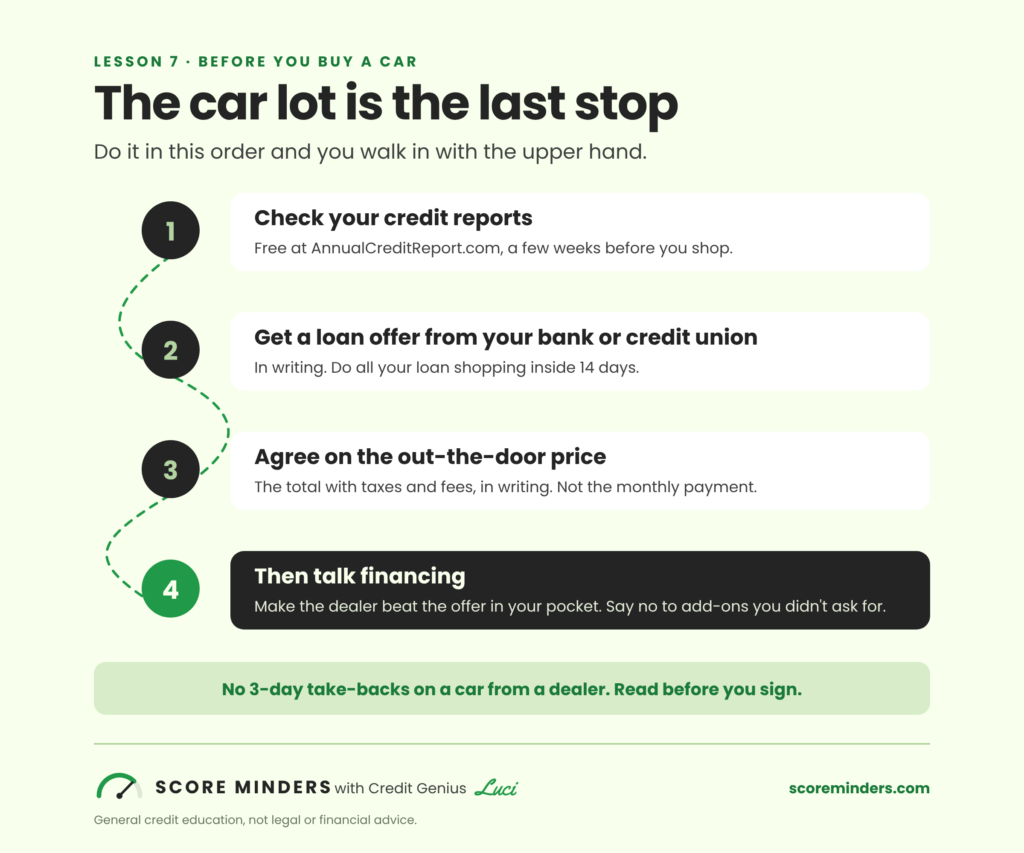
Here’s the order:
- Check your credit reports.
- Line up a loan offer from your bank or credit union.
- Then go shopping, and treat the dealer’s financing as just one more offer to compare.
Step 1: Check your credit reports first
Pull all three reports for free at AnnualCreditReport.com a few weeks before you shop. Use the free guide and lesson 2 to go through them section by section. Found a mistake? You can dispute it for free with the bureau and the company that reported it. Starting early gives that time to work.
Know which score the lender is looking at. The score in your free app probably isn’t it. Many auto lenders use a FICO Auto Score, which runs from 250 to 900 instead of the usual 300 to 850, and weighs how you’ve handled car loans before. The common versions:
| Bureau | FICO Auto Score versions |
|---|---|
| Experian | 9, 8 and 2 |
| Equifax | 9, 8 and 5 |
| TransUnion | 9, 8 and 4 |
FICO Auto Score 10 is also out now. And a lender can use a different score altogether. That’s why the dealer’s number rarely matches your app (lesson 3).
Your move: when the lender or dealer pulls your credit, ask which score and which bureau they used. If you’re turned down or offered worse terms because of your report, you have the right to know which bureau it came from and to get a free copy (lesson 4).
Step 2: Get a loan offer before you get a car
Go to your bank or credit union first and ask for a written loan offer showing the interest rate (APR), how many months, and the most they’ll lend you. Ask two or three places and compare.
Now you walk onto the lot with a number in your pocket. If the dealer can beat it, great. If not, you already have your loan.
“Won’t all those applications hurt my credit?” Here’s the rule: when you shop for one car loan, the scoring models treat several lender checks made close together as one inquiry. The CFPB says checks made within 14 to 45 days of each other generally count as one. Keep all your loan shopping inside 14 days and you’re covered either way.
That only works for the same kind of loan. Car loan checks count together. A credit card application in the middle of car shopping counts on its own.
Get it in writing. Always. The loan offer, the rate, the term. If it’s not in writing, it doesn’t exist.
How dealer financing really works
When the dealer “finds you a loan,” here’s what usually happens behind the desk:
- The dealer sends your application to one or more lenders.
- A lender tells the dealer the interest rate it will accept for you.
- The dealer can offer you a higher rate than that. The difference is the markup, and the lender shares that extra money with the dealer. That’s how the dealer gets paid for arranging the loan.
- You sign, and the dealer usually sells your contract to that lender.
Nothing about that is hidden in a back room. It’s just not something they announce. The FTC says the APR you’re offered “usually includes an amount that compensates the dealer.”
This is why Step 2 matters. With your own loan offer in hand, you can see the markup. And the rate is negotiable, just like the price of the car.
Sometimes dealers really do have the better deal, like a special low rate from the car maker. Compare the APR, the number of months and the total amount financed, side by side, and pick the best one.
Traps to watch for
“What monthly payment are you looking for?” Don’t answer that. A payment can be made to fit almost any number by stretching the loan longer, and then you pay more in the end. Settle the out-the-door price first (the total with taxes and fees), in writing. Then talk financing.
The long loan. 72 and 84-month loans make the payment smaller and the total cost bigger. The CFPB’s example: a $20,000 loan at 4.75% costs $1,498 in interest over 3 years and $3,024 over 6 years. Longer loans also keep you owing more than the car is worth for longer.
Add-ons. Extended warranties or service contracts, GAP coverage, credit insurance, window etching, paint protection. All optional, and the prices are negotiable. Ask what each one costs before you agree to anything. Check whether your own car insurance already covers it. And if a dealer tells you credit insurance is required, federal law doesn’t require it, and if the dealer makes it a condition, the cost has to be counted in your APR.
“Take it home tonight, we’ll finish the paperwork later.” If your financing isn’t final, the dealer may call days later saying the loan fell through and you need to sign a new deal, often with a higher rate. Some people call this a yo-yo deal. Protect yourself:
- Ask point blank: “Is my financing final?” Get the answer in the contract.
- Get it in writing that the dealer won’t sell your trade-in until the financing is final, and will give back your down payment if it falls through.
- You don’t have to accept a new deal. If you walk away, ask for your down payment and your trade-in back, and get written proof the contract was canceled.
- If it’s not final, think about waiting and keeping your current car until it is.
Fees. Taxes, title and registration are set by the government and can’t be negotiated. Dealer fees (document, prep, delivery, “market adjustment”) often can.
Cosigning: think twice
Asked to cosign for someone? Or thinking of asking someone to cosign for you? Know what it means:
- A cosigner owes the whole loan. Not a backup. If the borrower doesn’t pay, the cosigner has to, plus late fees and collection costs. In many states the lender can come after the cosigner without trying the borrower first.
- It’s on the cosigner’s credit report. Every late payment shows up there too. And even when it’s paid on time, lenders count it as the cosigner’s debt.
- The cosigner doesn’t own the car.
- The lender has to give the cosigner a written “Notice to Cosigner” spelling this out. Read it.
Before you sign: your checklist
- Out-the-door price agreed, in writing
- Your own loan offer in hand to compare
- APR, number of months and amount financed match what you agreed to
- Every add-on is one you chose, with its price listed
- No blank spaces in the contract
- Financing is final, in writing (or you’re keeping your current car until it is)
- You read it all, at your own pace. Don’t let anyone rush you, especially on a signing tablet
- A signed copy of the complete contract goes home with you
Myth: “Buyer’s remorse gives me 3 days to return the car”
It doesn’t. This one catches a lot of people, so read it twice.
The “buyer’s remorse” 3-day rule people talk about is the FTC’s Cooling-Off Rule. It’s real, but it only covers sales made away from the seller’s regular place of business, like a salesperson at your front door or a booth at a hotel or fair. It does not cover:
- anything you buy at the seller’s regular place of business, like a car on the dealer’s lot
- cars, trucks or vans sold at a temporary spot (a tent sale, a parking lot event) when the dealer also has a regular lot
Texas has its own 3-day rule too (Business and Commerce Code 601.002), and it’s the same idea: sales made away from the seller’s place of business, like at your home or an event. Not at a dealership.
Bottom line: once you sign at the dealership, the car is yours. There’s no buyer’s remorse period to fall back on. So slow down, read every page, and don’t sign until you’re sure.
“But I heard there’s a 3-day right to cancel a loan.” There is, but not for car loans. That’s the right of rescission, and it covers loans that use your home as collateral, like a refinance or a home equity loan (lesson 8). It doesn’t cover car loans, or even the mortgage you use to buy a house.
In Texas: the Texas State Law Library says no state law gives you 3 days to return a car. One narrow exception: if you financed through the dealer and the dealer never gave you a copy of the accepted contract, you may be able to cancel before you get the car and get your money and trade-in back (Texas Finance Code 348.110 and 348.111). Some dealers also offer their own return or cancellation option. If it’s not written in your contract, don’t count on it.
And you know the rule by now: if it’s not in writing, it doesn’t exist.
Sources
CFPB, "How will shopping for an auto loan affect my credit?": consumerfinance.gov
CFPB, "What things can I negotiate when shopping for a car or auto loan?": consumerfinance.gov
CFPB, Auto Finance fact sheet (dealer markup): consumerfinance.gov
FTC, "Financing or Leasing a Car": consumer.ftc.gov
FTC, "Buying a Used Car" (dealer financing, keep your trade-in and down payment safe): ftc.gov
FTC, "Cosigning a Loan FAQs": consumer.ftc.gov
FTC, "Buyer's Remorse: The FTC's Cooling-Off Rule": consumer.ftc.gov
myFICO, FICO Score versions (FICO Auto Scores, 250 to 900): myfico.com
Texas State Law Library, "Can I return a car after I buy it?": sll.texas.gov
Experian, "What Is the Right of Rescission on Home Loans?": experian.com
TexasLawHelp, "The 3-Day Right to Cancel a Purchase" (Texas Business and Commerce Code 601.002): texaslawhelp.org
All checked October 27, 2026.
General credit education only, not legal or financial advice. We don't review credit reports, file disputes or offer credit repair services.
Get the next lesson