
Learn › Credit Genius Luci lessons › Lesson 8
Before You Apply for a Mortgage
The biggest loan, the closest look
A mortgage is the biggest loan most families ever take on, and the lender looks at everything: all three credit reports, your income, your debts, your bank statements, your job history. Sometimes twice.
That’s not a reason to be scared of it. It’s a reason to get ready for it.
The people who have the smoothest time aren’t the ones with perfect credit. They’re the ones who started early, knew what the lender would look at, and didn’t make any big moves in the middle. That’s what this lesson is about.
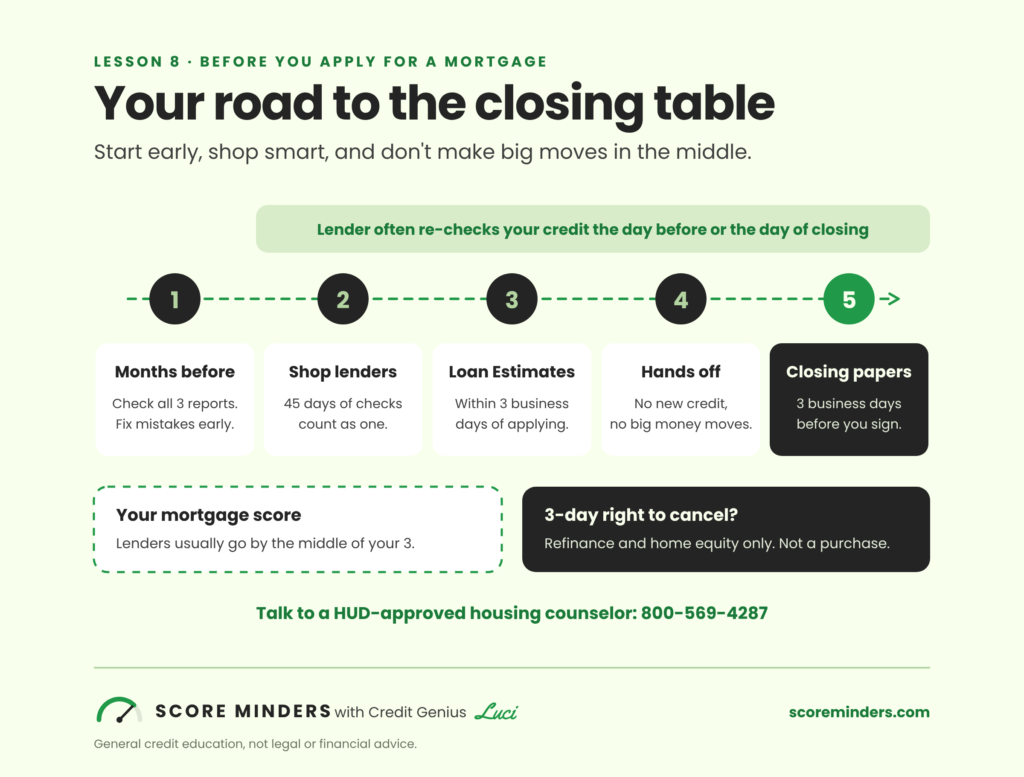
Start early: months, not days
Pull all three reports free at AnnualCreditReport.com several months before you plan to apply. Checking your own credit never affects your scores.
Why months? Because if something on your report is wrong, a dispute takes time: the bureau generally has 30 days to look into it, and then the fix has to show up on your report before the lender pulls it. Finding a mistake the week before you apply is how closings get delayed.
Go through each report with the free guide and lesson 2. Look extra hard at:
- Accounts you don’t recognize and debts that aren’t yours
- Late payments you didn’t make
- Collections listed twice, even under different account numbers
- Balances that are wrong or old
- Old addresses and names. A mortgage lender sees these too, and will ask about them
And while you’re at it: gather your paperwork now. Pay stubs, W-2s or tax returns, bank statements. Lenders ask for a lot, and having it ready keeps things moving.
The scores mortgage lenders use
This is where the score in your app surprises people the most (lesson 3).
For most mortgages backed by Fannie Mae or Freddie Mac, the lender pulls all three credit reports at once. Then:
- The score model: the lender can use classic FICO (older versions, one per bureau) or, since September 9, 2026, VantageScore 4.0. It picks one model per loan and uses it for everyone on the loan. FICO 10T is approved but not in use yet.
- Which of the three scores counts: usually your middle score. Scores of 690, 702 and 715? The lender goes by 702.
- Applying with someone else? The lender looks at both of you, so both of your reports matter.
The score in a free app is usually a newer version from one bureau, so it’s a ballpark at best. Ask your lender which model they used and what your three scores were. And remember: lenders also look at your whole report, not just the number.
Debt-to-income: the number nobody tells you about
Your credit score isn’t the only number. Lenders also look at your debt-to-income ratio (DTI): how much of your monthly income already goes to debt payments.
How to figure it: add up your monthly debt payments, then divide by your gross monthly income (before taxes and deductions).
A made-up example. Sam makes $6,000 a month before taxes. Sam’s monthly payments:
| Payment | Monthly |
|---|---|
| New mortgage payment | $1,500 |
| Car loan | $100 |
| Credit cards and other debts | $400 |
| Total | $2,000 |
$2,000 ÷ $6,000 = 33% DTI.
Different loans and lenders set different DTI limits, so there’s no one magic number. But now you know what they’re looking at, and you can run your own numbers before they do.
Things that count: minimum payments on credit cards, car loans, student loans, personal loans, and the new house payment. Things that usually don’t: utilities, groceries, phone bills.
Shop around. It’s worth it.
A lot of people take the first mortgage offer they get. Don’t. A small difference in the rate adds up over 15 or 30 years.
Get offers from at least three lenders: a bank, a credit union, a mortgage broker or online lender. Mix it up.
“Won’t all those credit checks hurt me?” The CFPB says mortgage credit checks within 45 days count as one inquiry, because lenders know you’re shopping for one home. Even if one lands later, one extra inquiry has a small effect next to what a better rate can save you.
Compare Loan Estimates, not sales pitches. Every lender has to give you a Loan Estimate within 3 business days of your application. It’s the same standard form from every lender, so you can lay them side by side and compare:
- the interest rate and the APR
- the monthly payment
- the closing costs
- the cash you need to close
Ask questions about anything you don’t understand. And get every promise in writing.
Hands off: what not to do until you close
Your credit gets checked again right before closing. Expect the lender to take one more look, usually within 1 to 3 days of closing, and often the day before or the day of closing. It’s usually a soft check that doesn’t affect your score, but it shows any new account, new balance or missed payment since you applied. Many lenders also call your employer in the last days before closing to make sure you still work there.
A new car loan or a maxed-out card showing up at that last check can delay your closing or change your loan. So from the time you apply until you have the keys:
- Don’t open new credit. No new credit cards, no car loan, no store card for the furniture. Each one adds an inquiry and new debt. (The furniture can wait. Seriously.)
- Don’t take on big new purchases on credit. It raises your debt-to-income ratio.
- Don’t close old credit cards without asking your lender first. It can change your numbers.
- Don’t change jobs without talking to your lender first, if you can help it. The lender may call your employer in the last days before closing to make sure you still work there, and a new job, a cut in hours or a switch from salary to commission can hold things up.
- Don’t move big amounts of money around or make large cash deposits you can’t explain with paperwork. Lenders ask where money came from.
- Don’t miss a payment on anything. Not the car, not the phone, not the card.
- Don’t cosign for anyone. That’s your debt now (lesson 7).
When in doubt, call your lender before you do it, not after.
Closing: your 3 days to look it over
You get the Closing Disclosure at least 3 business days before closing. It shows the final loan terms and every cost.
Use those 3 days. Lay it next to your Loan Estimate and check that the rate, the monthly payment and the closing costs match what you were promised. If something changed, ask why, before closing day, not at the table.
If certain big things change after you get it, like the APR going up beyond a small amount, the loan type changing, or a prepayment penalty being added, the lender has to give you a new Closing Disclosure and a new 3-business-day wait.
What about the 3-day right to cancel? That’s the right of rescission, and it’s not for the mortgage you use to buy a home. It covers loans that use the home you already live in as collateral, like:
- a refinance
- a home equity loan
- a home equity line of credit (HELOC)
With those, you generally have 3 business days after signing to cancel. Buying the house? No take-backs once you sign. So read before you sign. Sound familiar?
Help is out there
HUD-approved housing counselors help with buying a home, understanding your options and avoiding foreclosure. Find one near you at 800-569-4287 or search online at answers.hud.gov/housingcounseling. Many offer homebuyer classes too, and some homebuyer programs may ask you to take one.
In Texas, two state organizations run homebuyer programs, including help with down payments for people who are eligible:
- Texas Department of Housing and Community Affairs (TDHCA): welcomehome.tdhca.texas.gov
- Texas State Affordable Housing Corporation (TSAHC): tsahc.org
Program rules, income limits and amounts change, so check their sites for what’s current.
A heads-up: anyone who promises to get you into a home “no matter what your credit looks like” for an upfront fee is a red flag. Real counselors and state programs don’t work that way.
Sources
CFPB, "What exactly happens when a mortgage lender checks my credit?" (45-day window): consumerfinance.gov
CFPB, "What is a debt-to-income ratio?": consumerfinance.gov
CFPB, Loan Estimate and Closing Disclosure timing: consumerfinance.gov and Know Before You Owe: Closing Disclosure
Regulation Z, 12 CFR 1026.19(f)(2)(ii) (changes that start a new 3-day wait) and 1026.23 (right of rescission)
FHFA, Credit Scores (classic FICO, VantageScore 4.0 since Sep 9, 2026, FICO 10T, tri-merge): fhfa.gov
Experian, "What Is the Right of Rescission on Home Loans?": experian.com
HUD, Housing Counseling: hud.gov
TDHCA homebuyer programs: welcomehome.tdhca.texas.gov
TSAHC homebuyer programs: tsahc.org
Redfin, "How Many Times Do Lenders Check Your Credit Before Closing?" (last check usually 1 to 3 days before, sometimes the day before or day of): redfin.com
Fannie Mae Selling Guide B3-3.1-07, verbal verification of employment within 10 business days of closing (via homebuyer.com): homebuyer.com
All checked October 27, 2026.
General credit education only, not legal or financial advice. We don't review credit reports, file disputes or offer credit repair services.
Get the next lesson