
Learn › Credit Genius Luci lessons › Lesson 9
Credit Checks for Jobs
Yes, some employers check your credit
You apply for the job. The interview goes great. Then they hand you a form asking permission to run a background check, and buried in it is your credit report.
It’s more common than people think, especially for jobs that handle money, sensitive information or security.
Here’s the good news: you have more rights here than almost anywhere else in the credit world. The employer needs your written permission first, they don’t see your credit score, and if something in that report costs you the job, they have to show it to you and give you a chance to respond.
Let’s walk through it.
Step 1: Your written permission comes first
Under the Fair Credit Reporting Act, before an employer gets your credit report from a background check company, it has to:
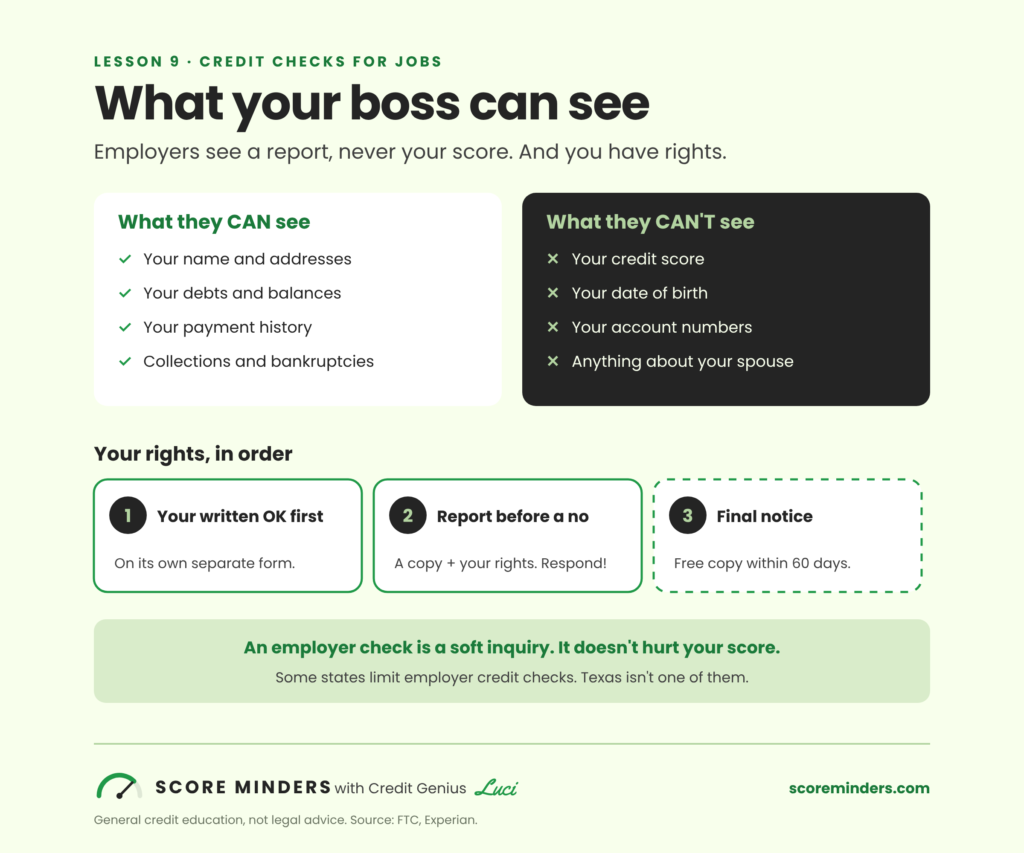
- Tell you in writing that it may use the report to make decisions about hiring, promotion or keeping you on. This has to be its own separate document, not tucked into the job application.
- Get your written permission.
That goes for current employers too, not just new hires.
Can you say no? Yes. But the FTC is honest about it: if you do, you may not get the job.
Does it hurt your score? No. An employer check is a soft inquiry. It shows up on your own copy of your report, but it doesn’t affect your score, and lenders don’t see it.
Step 2: What they see, and what they don’t
An employer gets a modified version of your credit report.
| They can see | They can’t see |
|---|---|
| Your name and addresses | Your credit score |
| Your debts: credit cards, car loans, mortgage, student loans | Your date of birth |
| Your payment history, including late payments | Your account numbers |
| Collections and public records like bankruptcy | Information about your spouse |
So when someone tells you “they won’t hire you with a score under 600,” that’s a myth. They never see the score. What they look at is the story your report tells: payment history, collections, how much debt you carry.
That’s also why lessons 1 and 2 matter here. Know what’s in your report before they do.
Step 3: If the report costs you the job, you get two notices
An employer can’t just quietly pass on you because of something in your report. The law makes them slow down.
Notice 1: before they decide. Before turning you down, or denying a promotion, because of the report, the employer has to give you:
- a copy of the report they used
- a “Summary of Your Rights” under the Fair Credit Reporting Act
This is your chance. If something in that report is wrong, or there’s an explanation (a medical bill, an identity theft, an old debt that’s settled), speak up now. Tell the employer, in writing.
Notice 2: if they still say no. The final notice has to tell you:
- the name, address and phone number of the company that supplied the report
- that the company didn’t make the decision and can’t tell you why
- that you have the right to dispute anything wrong or incomplete in the report
- that you can get another free copy of the report if you ask within 60 days
Found a mistake? Dispute it with the company that supplied the report, send copies of anything that backs you up, and ask them to send the corrected report to the employer. And as always: get it in writing.
Some states limit employer credit checks. Texas isn’t one of them.
Federal law sets the rules above in every state. Some states go further and limit when an employer can use your credit at all. As of October 2026, 11 states do:
California, Colorado, Connecticut, Hawaii, Illinois, Maryland, Nevada, New York, Oregon, Vermont and Washington. Some cities, like New York City and Chicago, have their own limits too.
The details differ. Most still allow credit checks for certain jobs, like ones that handle money or work in law enforcement.
In Texas, we didn’t find a state law limiting employer credit checks. The federal rules (permission, the two notices, your right to dispute) still apply in full.
Laws change, so if you live somewhere else, check your state’s labor or consumer protection office.
Your moves before and during a job search
- Pull your own reports first at AnnualCreditReport.com. They’re free every week. No surprises.
- Dispute mistakes now. Disputes take time, and you want them done before an employer looks.
- Read the permission form before you sign it. Know what kind of check they’re running.
- Keep a copy of everything you sign and every notice you get.
- Got a pre-adverse action notice? Read the report right away and respond in writing if anything’s wrong or needs explaining.
- Turned down? Use your free copy within 60 days, and dispute anything wrong.
- See a soft inquiry from an employer you never gave permission to? That’s worth asking about.
A report with some old bumps doesn’t automatically cost you a job. Being ready to explain it often matters more than people think.
Sources
FTC, "Employer Background Checks and Your Rights": consumer.ftc.gov
FTC, "Using Consumer Reports: What Employers Need to Know": ftc.gov
Fair Credit Reporting Act, 15 U.S.C. 1681b(b) (employment use) and 1681m (adverse action notices)
Experian, "Do Employers Check Credit Scores?" (modified report, soft inquiry): experian.com
State limits on employer credit checks (11 states, NYC, Chicago), as of Oct 2026: beancount.io
All checked October 27, 2026.
General credit education only, not legal or financial advice. We don't review credit reports, file disputes or offer credit repair services.
Get the next lesson