
Learn › Credit Genius Luci lessons › Lesson 3
How Credit Scores Are Calculated
Your report and your score are two different things
Your credit report is the record. Your credit score is a number a computer model calculates from that record, usually somewhere between 300 and 850. The report doesn’t come with a score attached; a score gets figured fresh each time someone asks for one.
That’s also why you don’t have just one score. There are different scoring companies (FICO and VantageScore are the big two), different versions of each, and three bureaus whose reports don’t always match. So the number your bank app shows you and the number a mortgage lender sees can be different, and both can be right. Lenders choose which score they use.
Different scores for different things
This is the part almost nobody tells you. There isn’t one FICO score. There’s a whole family of them, and the one a lender pulls depends on what you’re applying for.
| What you’re applying for | Score they usually use | Range |
|---|---|---|
| Credit cards, personal loans | Often FICO Score 8, or a FICO Bankcard Score | 300 to 850 (Bankcard: 250 to 900) |
| A mortgage | “Classic” FICO: Score 2 at Experian, Score 5 at Equifax, Score 4 at TransUnion. Since September 2026, Fannie Mae and Freddie Mac loans can use VantageScore 4.0 instead | 300 to 850 |
| A car loan | A FICO Auto Score (versions 8, 9, or an older one at each bureau) | 250 to 900 |
| Car, home or renters insurance | A credit-based insurance score, built to predict insurance claims, not loan payments | Varies |
| A job | No score at all. Employers get a limited version of your credit report and never see a score. | n/a |
The car lot surprise. This is the one that messes people up the most. You check your free app, see a decent number, and walk into the dealership feeling good. Then the finance guy tells you a different number. Nobody’s lying. Your app probably showed a VantageScore, and the dealer pulled a FICO Auto Score, which is built just for car loans, weighs your past car loan history more heavily, and runs on a different scale (250 to 900). Different ruler, different number.
Why your three bureau scores don’t match. Each bureau has different information on you, because not every lender reports to all three, and they don’t all report on the same day. On top of that, FICO says each bureau’s FICO scoring is tuned to its own data. So even the same version of FICO can come out differently at Equifax, Experian and TransUnion. A gap of several points, or more, between bureaus is normal.
The five things a FICO score looks at
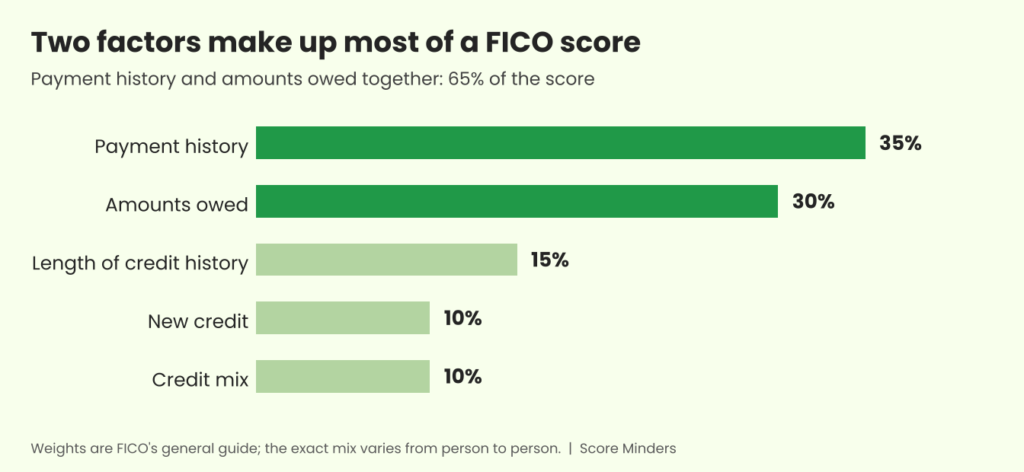
Paying on time and how much you owe make up nearly two thirds of the score. The other three matter, but much less.
Each piece in plain talk
Payment history (35%). Did you pay on time? Late payments, collections and bankruptcies all land here. Recent and more serious problems count more than old, small ones. Myth: paying a few days late wrecks your score. As you saw in lesson 2, a payment usually isn’t reported late until it’s 30 days past the due date. You’ll likely pay a late fee, though.
Amounts owed (30%). How much you owe, and how much of your available credit you’re using. Owe $300 on a card with a $1,000 limit and you’re using 30% of it. This is often called your credit utilization. Myth: you have to carry a balance and pay interest to build credit. You don’t. Paying in full counts as paying on time.
Length of credit history (15%). How old your oldest account is, how new your newest one is, and the average age of them all.
New credit (10%). Accounts you opened recently and hard inquiries from the past 12 months. Several new accounts in a short time can look risky to a lender. Myth: checking your own credit hurts your score. It doesn’t. That’s a soft inquiry. And when you shop around for one mortgage or car loan, several inquiries in a short window are generally counted as one.
Credit mix (10%). The kinds of credit you have: credit cards, store cards, installment loans like a car loan, and mortgages. Myth: you need one of every kind. You don’t. This piece matters less than the others, and nobody needs to take on a loan just to change it.
FICO vs VantageScore
Both run from 300 to 850, and both look at the same kinds of things. A few differences:
| FICO (classic) | VantageScore 4.0 | |
|---|---|---|
| History needed for a score | Usually at least 6 months with an active account | As little as 1 month |
| Looks at | Mostly a snapshot of your report right now | How your balances trend over time, too |
| Paid collections | Some versions ignore them | Ignored |
Watch out for the free app number. Many free score apps show you a VantageScore. It’s fine for keeping an eye on things, but it may be nothing like the score a lender pulls. Most loan decisions are still made on some version of FICO, and as you saw above, it may not even be the FICO version you’ve seen. Before a big application, ask the lender which score they use, and look at that one if you can.
What’s NOT in your score
Per FICO, your score does not look at:
- Your race, color, religion, national origin, sex or marital status
- Your age
- Where you live
- Your salary, job, employer or work history
- The interest rates on your accounts
So a high income doesn’t buy a high score, and a modest one doesn’t sink it. The score is about how you’ve handled credit, period.
Sources
myFICO: What's in my FICO Scores? (the five factors and weights, what's not considered)
Equifax: VantageScore 4.0 vs classic FICO (ranges, history needed, trended data, paid collections, under-$100 collections)
myFICO: FICO Score versions (mortgage Scores 2, 5, 4; Auto and Bankcard versions; 250 to 900 range)
myFICO: Why are my credit scores different? (different data and bureau-tuned scoring)
FHFA: Credit scores (VantageScore 4.0 allowed for Fannie Mae and Freddie Mac loans since September 9, 2026; Classic FICO still approved)
Experian: Why do employers check credit? (employers never see your score)
General credit education only, not legal or financial advice. We don't review credit reports, file disputes or offer credit repair services.
Get the next lesson